
· by Michael Blair, Nashville's Crawl Space Repair
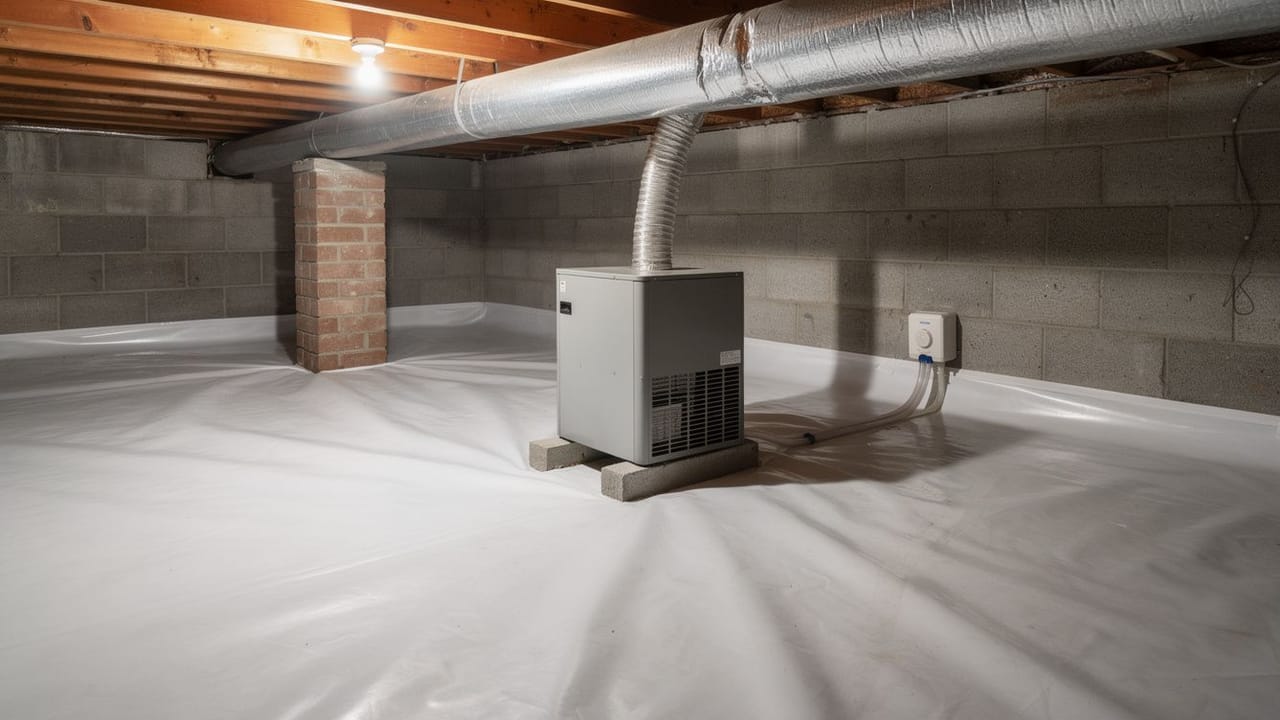
Sealing a crawl space cuts off the outside air, but the space still needs a way to take moisture out. The Department of Energy’s Building America guide to unvented crawlspaces says the 2009 building code it was written to called for a drying mechanism, such as a continuously running exhaust fan or a supply of conditioned air, and its photo of a finished sealed crawl shows a dehumidifier doing that job. That unit is the center of our moisture and dehumidification work. Because it lives in the dark and nobody looks at it, the failures we find are simple ones: a full bucket, a blocked drain, a unit placed where it cannot circulate air, or a household model that has quietly stopped.
What humidity should a crawl space dehumidifier hold?
Keep the relative humidity below 60 percent. That is the line EPA’s brief guide to mold, moisture and your home gives for indoor air, with 30 to 50 percent as the ideal, and the Department of Energy’s Building America guide to whole-house dehumidification designs to the same 60 percent. The number matters more under a house than in it: EPA’s mold course names humid crawl spaces as common sites of hidden mold growth, worst of all over a bare earth floor. The DOE guide gives 55 percent as an example setting for dehumidification to start, which leaves some margin under 60, and we set the units we install between 50 and 55.
We put the hygrometer at the far end of the crawl space from the unit, not beside it. The air coming out of a dehumidifier has just been dried, so a reading next to it says little about the far corners. A remote sensor you can read from the house is worth having, because otherwise nobody knows the unit has stopped until the musty smell upstairs gives it away. EPA’s mold course is plain about why: moisture that builds up in a crawl space can pass into the rest of the building through cracks in walls, floors and ceilings.
Draining, which is where they fail
A crawl space unit pulls water out of the air all summer, and that water has to go somewhere without a person emptying a bucket. ENERGY STAR’s dehumidifier guide says most whole-home units come with only a drain, routed to a floor drain or a condensate pump, and the DOE guide says a drain line must run to the outdoors or to a drain inside the home. We use gravity to a floor drain or sump wherever one sits lower than the unit, since there is no pump to wear out. Where the crawl space is lower than any drain, a condensate pump lifts the water to a drain line or outside. Many of those pumps have a safety switch that can shut the dehumidifier off if the pump fails; we follow the pump maker’s instructions and connect it when it is there.
Discharging outside through the foundation wall works as long as the line falls the whole way or is pumped, cannot freeze, and does not empty at the foundation to soak straight back in. ENERGY STAR makes the related point that better drainage around a foundation can lower the humidity inside. When we find a unit that has flooded its own floor, the drain line is the first thing we trace, looking for a stretch that runs uphill, a kink, or an end that stops in the crawl space gravel. If the crawl already has a sump, or needs one, that is part of our drainage and sump systems.
- Gravity drain to a sump or floor drain where one sits lower than the unit
- Otherwise a condensate pump, with its safety switch connected if it has one
- Drain line laid to fall the whole way, as the unit’s manual directs, with no kinks
- Outlet clear of the foundation and protected from frost
Placement and air movement
A dehumidifier dries the air that reaches it. In a long crawl space broken up by piers and ductwork, air at the far end may barely reach the unit. We set it near the middle, up off the liner so it never sits in water, mounted the way its manual allows, and where a dead end still reads damp we add ducting or a small fan to bring that air toward it.
In a sealed crawl space where the heating and cooling equipment sits elsewhere, the DOE crawlspace guide describes bringing in a small amount of conditioned air through a passive return cut into the floor, at 1 cfm for every 50 square feet of floor area or 50 cfm total, whichever is greater. That rate comes from the 2009 code the guide cites, and Metro Nashville now lists the 2024 International Residential Code with local amendments, so we confirm the current requirement before relying on it. When we do an encapsulation, we still fit a dehumidifier alongside any conditioned-air supply and let the hygrometer show whether it is needed.
Why not use a household dehumidifier down there?
Portable dehumidifiers from a hardware store are made for a room in the house. ENERGY STAR describes them as typically drying a single room or space, collecting water in a bucket, and usually shutting off automatically when that bucket is full. Under a house, that shutoff is the failure: the unit stops and nobody is down there to see it. Some have a fitting for a hose at the bucket, which helps only if the hose can reach a floor drain or sump on its own fall.
The units we fit in crawl spaces drain through a line, and before we choose one we read its spec sheet for the temperatures it is rated to run in, whether it restarts on its own after a power cut, and how it defrosts in a cold crawl. Whatever you buy, look for the ENERGY STAR label: ENERGY STAR says certified models use 20 percent less energy than a similarly sized conventional unit. If yours is a bucket model and the crawl still smells damp, ask us for a free estimate.
Sources
- US EPA, A Brief Guide to Mold, Moisture and Your Home — Keep indoor relative humidity below 60 percent, ideally 30 to 50 percent
- US EPA, Mold Course Chapter 2 — Humid crawl spaces are common sites of hidden mold, worse over bare earth; crawl space moisture passes into the building
- ENERGY STAR, Dehumidifiers — Whole-home units drain to a floor drain or condensate pump; portable units use a bucket with automatic shutoff and some take a hose; foundation drainage; certified units use 20 percent less energy; 30 to 50 percent ideal
- DOE Building America Solution Center, Unvented, Insulated Crawlspaces (2021) — 2009 IRC R408.3 drying mechanism; conditioned air through a passive return at 1 cfm per 50 square feet or 50 cfm; dehumidifier keeps a sealed crawlspace dry
- DOE Building America Solution Center, Whole-House Dehumidification (2018) — Maintain relative humidity below 60 percent; example setpoint of 55 percent; drain line routed outdoors or to an inside drain
- Metro Nashville Codes, Adopted Codes List — 2024 International Residential Code adopted with local amendments
FAQ
Running a Crawl Space Dehumidifier Properly — questions
What humidity should a crawl space be kept at?
Below 60 percent relative humidity. EPA advises keeping indoor humidity under 60 percent, and both EPA and ENERGY STAR put the ideal between 30 and 50 percent. We set crawl space units between 50 and 55 to leave a margin, and we read the humidity at the far end of the space from the unit, away from the air it has just dried.
Does a crawl space dehumidifier run all the time?
It should not need to. A unit is sized to the moisture load of the space and controlled by a humidity setting, so a properly sized one switches on and off as the humidity crosses that setting. When one runs constantly and never reaches its setting, we check whether it is too small for the space, whether it is fighting an open vent or a water problem, and whether its coil needs cleaning.
Where does the water from a crawl space dehumidifier go?
By gravity to a floor drain or sump if one sits lower than the unit, otherwise through a condensate pump to a drain or to the outside. ENERGY STAR and the Department of Energy both describe those routes. We never leave a crawl space unit on a bucket, since a full bucket typically shuts the unit off, and we lay the drain line so it falls the whole way to its outlet.
Do crawl space dehumidifiers work?
They do in a sealed crawl, where the vents no longer let humid outside air in, provided the water drains away on its own and air can reach the unit. The failures we find are simple ones: a full bucket, a blocked drain line, a unit tucked where it cannot circulate air, or a household model that quietly stopped.